Nørregade is part of medieval Skive and a central shopping street.
The growing car traffic after the Second World War put the street under pressure, and as early as 1959 the street was made one-way. However, this was not enough to ease the pressure, and from September 28, 1968, as an experiment, the street was closed to traffic and made a pedestrian street. The status as a pedestrian street was quickly made permanent, followed by Adelgade and Frederiksgade in 1979 and Thinggade in 1992.
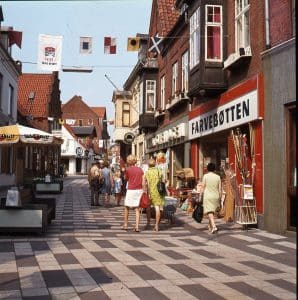
Business etc.
As an active commercial street throughout Skive’s history, many different businesses have been located here. The list can therefore only be seen as a small selection. For example, it can be mentioned that Skive’s first cooperative was established here in 1905, but it moved to Torvegade already in 1911.
Ramsgaard’s bookstore:
Nørregade 7 dates from 1908, when Niels Jessen Rydtoft (born 1881) founded Rydtofts boghandel. In 1934 it was taken over by Christian Ib Ramsgaard. The store continued with changing owners until 2012.
Vulkan:
Nørregade 13 was built in 1935, and from construction until the closure of “Vulkan” in 1987, it was a car dealership. The building was designed by architect Tage Hansen and is a fine example of functionalism.
Other interesting buildings
Nørregade 22
was built in 1896 on the site of Lorentzen’s property. A 2-storey property was built with shops on the ground floor facing the street and living quarters on the 1st floor. In the courtyard, premises for a printing house were built. The building was designed by gasworks master Isidor von Essen.
Nørregade 32 “Selchaus Gård”:
Built in 1841 by merchant Mikkel Thorup. In 1904 it was taken over by merchant Aage Selchau, who gave his name to the building. The grain store dates from the 1700s and was originally located behind Skive Town Hall on Torvet, where it was used as a royal granary. In 1866 it was moved to its current location
Nørregade 17:
Thomsen’s leather goods store built in 1923 with tanner L. Thomsen as the builder. An example of historicism designed by architect Erik V. Lind
Nørregade 21:
Skive’s old post office, then a watchmaker’s shop was run here, most recently the shop “Høg Møller”, which was located in the building until it was demolished in 2020.
Sources
- Mortensen, Niels, 125 år på Skiveegnen, Skive bogtrykkeri 2001, p.13, 220
- 13 (ramsgaardsboghandel.dk)
- Eskildsen Jens & Mortensen Niels, 43 spændende bygninger i Skive bykerne, Skive Museums Forlag 1998