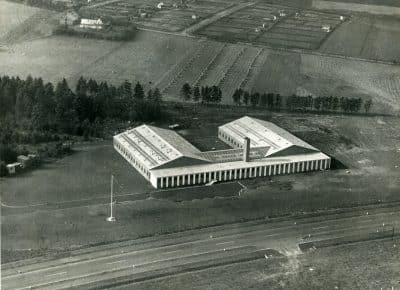
Metallic Trykstøstøberi – in the 1970s the largest industrial workplace in the municipality. Until its closure in 2003, it was located at Sdr. Boulevard 14.
The early history
Trykstøstøberiet Metallic was founded in 1945 by engineer Peder Brinch-Møller and hardware wholesaler Erik Mangor.
Erik Mangor was a trained hardware merchant and after his apprenticeship, he worked at various factories in the lock and hardware industry. In 1939, he joined his uncle – Kai Fog’s agency company, which was founded in 1913. The company sold small personal care items, scissors and locks – many items that came from Germany.
Peter Brinch-Møller, a trained engineer, was employed from 1942 as an operating engineer at “Valdemar Larsen’s injection molding company H.P. Larsen” with the task of getting replacement goods going during the war. These were building fittings, door locks, keys, etc.
During the war, Mangor and Brinch-Møller met each other, as Mangor sold many of the foundry’s products. Many ideas were hatched between the two and in 1945 they agreed to start their own company under the name “Metallic Trykstøberi og Metalvarefabrik”.
From the start, it was agreed that Mangor would sell the products through the company “Fog og Mangor” and Brinch-Møller as technician would be the “producing party”.
Metallic started in the basement of a house in Brønshøj, where an injection molding machine for zinc was constructed and production of window hooks, door handles, shelf supports, pins and nails began. In 1947, Metallic established a large program of scissors production and it was a good business. Three years later, the company moved to new factory premises in Herlev.
after the war, “Fog og Mangor” was able to rebuild the agency and wholesale business with goods they had previously carried, but also gradually household goods such as milk straighteners, egg dividers, tea eggs, can openers and wheel whisks (the first product to be branded EVA after Mangor’s eldest daughter) – many of the items produced at Metallic.
The production
Die casting is a casting technique that is particularly suitable for zinc, aluminum and magnesium. The process takes place under high pressure and is therefore very fast. Die casting can be used to produce very precise and complex parts, such as components for motors and electrical devices.
Metallic made semi-finished products that were used in other companies’ finished products. For example, they cast frames for B&O tape recorders, parts for SAAB and Scania-Vabis car production and components for Elektrolux, Asea and Bacho.
Relocation to Skive’s newest industrial district
In the mid-fifties, EVA household machines, as a department within Metallic, began producing household machines, partly slicers for private households and partly a very popular coffee machine.
In the mid-sixties, production could not be expanded any further in Herlev, where 250 employees were employed. The site was built out and it was difficult to find labor.
The company investigated various options for relocation from the metropolitan area. Interest focused on 2-3 locations, with Skive offering the best opportunities.
Strongly encouraged by Mayor Wolhardt Madsen and engineer Poul Hj. Sørensen, Metallic opened a branch in Skive in 1962. It was the first company to be built in the new Egeris district south of the city. Thus, the 1950s plans for a new neighborhood with housing, industry, schools and institutions were realized.
The relocation of the branch went well, so EVA Husholdningsmaskiner A/S was transferred to Skive in 1964 and in 1966 Metallic moved its headquarters and its entire production to Skive. In 1971, there were 483 employees in Skive and an annual turnover of almost 45 mill. kr. Metallic was thus the largest industrial workplace in the municipality.
Management and employee care
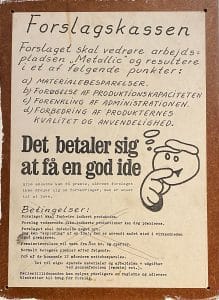 Founder and CEO Peder Brinch-Møller left his mark on the factory’s management and introduced a modern management style – by the standards of the time.
The factory’s motto – displayed in the production halls – was:“It is the ability to will that gives the ability to do“. By this, Peder Brinch-Møller meant that employee motivation was important for the company, and in order to be motivated, it was important to be able to see the context of what you were working on.
The company therefore made a lot of effort to keep employees informed. There were weekly meetings between management and department managers where everything from the previous week was discussed. Minutes of these meetings were distributed to shop stewards and posted on notice boards. There were accounting meetings once a year, where everything was laid out openly for the employees.
New employees were given a tour of the factory and given a booklet explaining the company, its rules and traditions, and the various benefits available to employees. Such as for example, a medical scheme, a holiday home and a nature plot with a campsite for employees to use, opportunities to apply for loans from the employee fund or grants that did not have to be paid back. “Family days” were held with entertainment, ice cream and soft drinks.
Growth – acquisitions
In the early 1970s, Metallic invested in automating production. Together with 7 other foundries in Europe and the US, they collaborated on the development of robots for the foundries.
Metallic expanded with departments in Roslev and Nykøbing. In 1977-80, five other companies in the foundry industry were acquired. Carl Cohns sønner in Valby and Metallic’s largest Danish competitor Gads Metalstøberi in Kastrup.
After this, Metallic accounted for 70% of Danish production of die castings and 90% of exports. Metallic was Northern Europe’s largest metal foundry with customers such as Volvo, Saab, IBM, Nilfisk, General Electric and Apple. Later, it cast housings for the radio part of the 80s car phone. After the acquisitions, the number of employees grew to 600, even though the factory in Skive, e.g. the factory in Skive had 50 robots in operation.
In the 1970s, Sdr. Boulevard had 19,000 m2 of factory premises and administration, but with Metallic’s continued expansion of subcontractor production, the entire facility was needed.
– and the budding of the company
In 1972, Metallic started a subsidiary, Temponik, specializing in the molding of plastic parts. Temponik moved together with EVA Husholdningsmaskiner to Rævevej in 1982. A spin-off from here became Metallic Plast, which was later sold to Rosti Plast, then part of the A.P. Møller Group, which built a new factory at Bjørnevej 3 in 1989.
In 1983, Eva Husholdningsmaskiner A/S moved to Roslev and the name was changed to Roslev Metalvarefabrik A/S – as they now produced as a subcontractor to many other companies. At the same time, the rights to the EVA trademark were transferred to Erik Mangor.
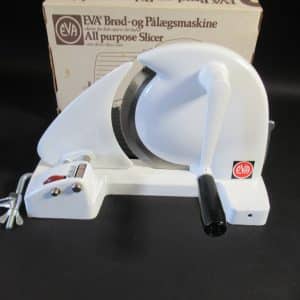
The EVA trademark
From 1960 until 1973, around 50,000 EVA machines were sold each year. The EVA machines accounted for a quarter of Metallic’s annual turnover. In 1980, over 25,000 units were still being sold annually, but sales gradually declined thereafter.
The EVA bread/spread machine was produced in Skive/Roslev until it was taken out of production in 1988.
Many other household products – produced by other subcontractors – were marketed under the EVA brand by Erik Mangor’s company over the years.
Temponik
In 1990, Temponik – where P. Brinch Møller was still CEO and board member – was separated from Metallic and moved back to Rævevej. Temponik’s specialty was making prototypes. In 2009, Temponik was taken over by the Skive company Idé-Pro.
Changes in management
In 1977, director P. Brinch Møller turned 60 years old and in this connection, the ownership of Metallic and EVA household machines was transferred to a foundation, the Metallic Foundation. Until then, the company had been owned by a few major shareholders, including the founders P. Brinch Møller and Erik Mangor.
In 1987, Jan Brinch Møller replaced his father in Metallic’s management and in 1988 he was appointed CEO.
Decline and bankruptcy
The 1990s saw an economic downturn in the automotive industry and this had consequences for suppliers like Metallic. The following years were not good for Metallic. In 1997, the Metallic Foundation had to give up. The company was taken over by ProCimbria Finance, owned by brothers Sven and Ole Toftdahl Olesen. Despite investments of 50 mill. it was not possible to turn Metallic into a profitable company.
In the fall of 2002, Metallic, which now had only 120 employees, went bankrupt. The trustees failed to sell the company and in March 2003 Metallic closed down.
The fate of buildings and facilities
Around 2004, the Museum Council of Viborg County designated the factory buildings to the Agency for Culture and Palaces as: “a fine example of an early and harmonious industrial building on the southern edge of Skive.”
The description read:
“The factory consisted of four large halls in red brick with an eternite roof. The halls were parallel to each other and were connected at the eastern end by an intermediate building. The two middle halls were from 1962. Until 1970, the plant was fully expanded.
The factory’s office building was two-story with a flat roof. The tight-fitting windows were separated by white painted “pillars”. Below the windows were red brick panels, creating a geometric pattern. On one side of the building was a wide, covered glass entrance. A basin with a fountain in front of the building served to collect cooling water from production.
The facility also included a caretaker’s residence in connection with the parking lot and a small red stone detached house with a tin roof.”
The assessment was :
Metallic’s former factory site is an example of the post-war relocation of industry from the capital to the provinces. It is also a testament to the urban planning of the 1950s and 60s. Locally, the company has been of great importance, for example, as a driving force in the development of toolmaker training in the area and for the establishment of a number of smaller machine factories.
Tax/ Trade union house/ Autism center
The investment company and project developer Difko A/S in Holstebro bought the bankruptcy estate of Metallic through a real estate company. The then newly established tax center temporarily rented the former administration building and liked the location.
The demolition of the factory buildings praised by the Danish Agency for Culture and Palaces was in full swing.
In 2010, Difko built 2000 m2 of commercial real estate on Jægervej 2, where Skattecenter Skive lives for rent.
In 2011, Fagforeningshuset opened at Jægervej 12 – a joint office building for HK Midt Vest, Dansk Metal, 3F and FOA.
In 2020, Skive Municipality built a new autism center on the Metallic site at Bilstrupvej 27, designed by Skala Arkitekter A/S.
What happened to Eva?
In 1953, Erik Mangor took over the company “Fog og Mangor” from his uncle and ran what later became EVA Danmark A/S from Rødovre in his own name. In 1970, the company was converted into a limited company and his son Johan Mangor joined. Now EVA Solo A/S is run by a grandson of Erik Mangor, Jan Engelbrecht.
Sources
- Skive kommunes historie fra 1940 – 2003 vol. 3, Skive Museums forlag 2003. P. 154 – 157, p. 383 – 385
- Kulturministeriet Slots- og Kulturstyrelsen, preservation-worthy buildings and environments, preservation themes, industrial culture
- “From Fog & Mangor” to EVA DENMARK A/S by Fritz Togo. Published on the company’s 100th anniversary
- The EVA spreading machine