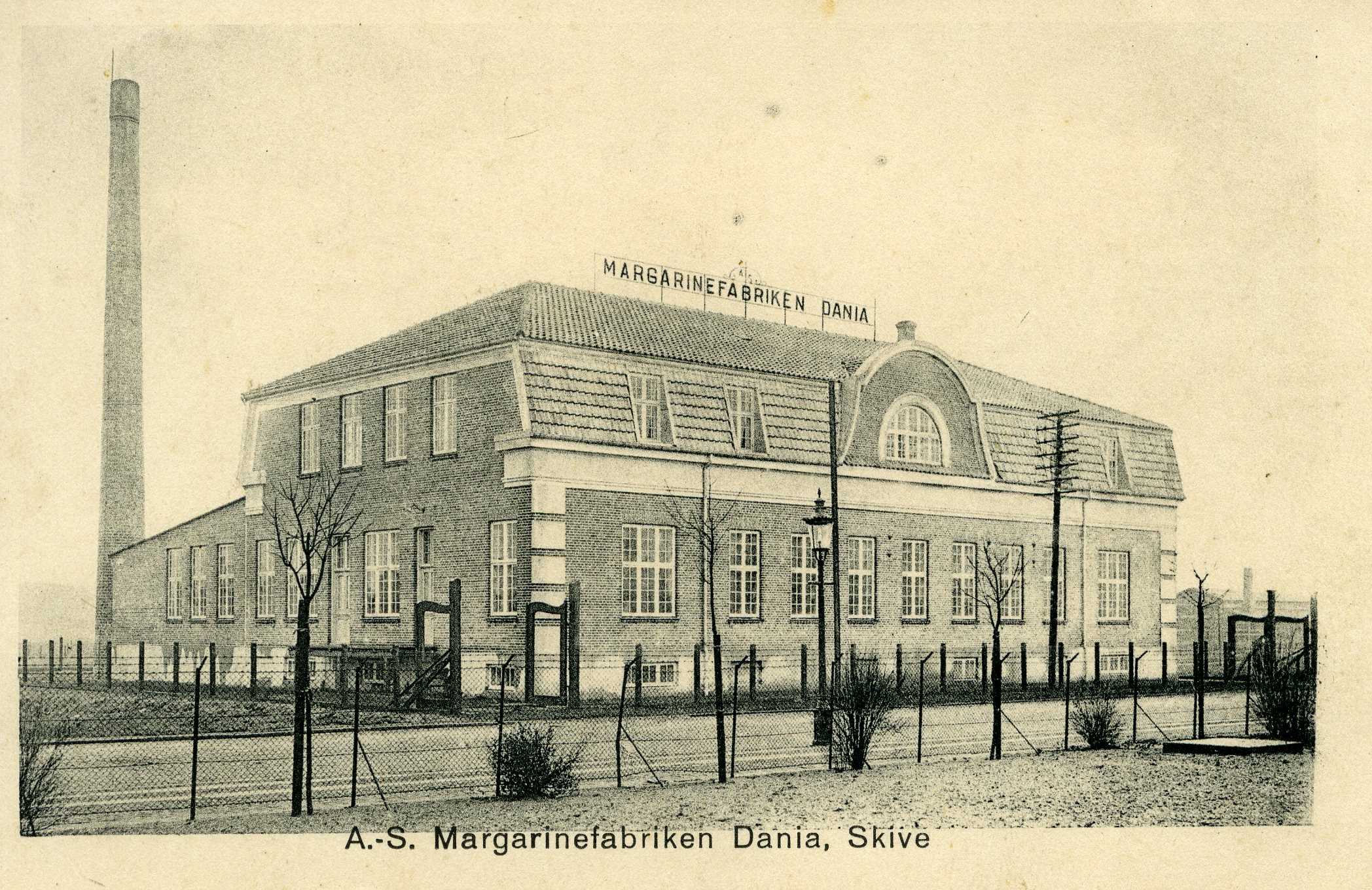
The margarine factory “Dania” was built in 1912 on the corner of Engvej and Jernbanegade (now Viborgvej 1) in Skive’s “new” industrial district close to the railway station. Dania was active from 1912 to 1938. The stately building later housed Lervarefabrikken Dania and, before its demolition, part of GYRO.
The early history
Johs. Thuesen from Randers – later director of the factory – together with miller Jensen, Vinderup and wholesaler Kastrup, Hadsten, took the initiative to start “Margarinefabrikken Dania”. The limited company started in 1911 with a share capital of DKK 50,000, which was increased to DKK 75,000 in 1914 and to DKK 100,000 in 1916.
The board of directors consisted of Møller Jensen, Vinderup, director Kastrup Hadsten Mølle, director Thuesen, landowner Brasch, Haraldsmark and proprietor Ohm, Hadsten.
The factory was to be located in a central location in West Jutland. Offers of free land were received from both Struer and Vinderup municipalities, but the choice fell on Skive, where they could get a cheap site with an excellent location near the train station.
Development of the industrial area east of Skive river
Dania became one of the first companies in the new industrial area on byfogedlodden.
Byfogedlodden was a large meadow area located opposite the Central Station. The name was due to the fact that the revenue from the area went to the City Bailiff’s Office. Time had run out on this way of generating income for “public servants” and the city council was ready to sell off the land.
9. on Jan. 1912, Skive Folkeblad reported that the city council in its closed meeting had approved the sale of 1 Td. land of byfogedlodden with 60 cubits of frontage along Jernbanegade to A/S Margarinefabrikken Dania for DKK 4000.
Folkebladet’s comment on the location of the margarine factory in Skive reads: “According to what we hear, one of the reasons why the company has chosen to locate the factory in Skive is the excellent water that we have heard that Skive is supplied with. It seems that Skive will now be as famous for its good water as it was previously notorious for its bad water.”
Establishment
Before construction could begin, a necessary “backfill” had to be started with earth fill brought in from Nørresøgade.
It was then a matter of finding an experienced margarine master. This was found in margarine master J. T. Hansen, who had worked for Otto Mønsted for 18 years and was trained in Holland. He had helped build Otto Mønsted’s factory in Aarhus and later a factory in England. He had last worked at Margarinefabrikken in Randers for 16 years and now happened to be available.
Traffic assistant Hansen-Leth from Randers designed the building, which was built by local craftsmen. The description in the above-mentioned article read: “Everything is solid and well executed, and the building thus stands as a telling testimony to the skill and ingenuity of the Skive craftsmen in the year of our Lord 1912.”

The large factory building was impressive by Skive standards, with the factory’s name in large letters across the roof ridge. The total price for the building and land amounted to DKK 100,000.
The trademark was a drawing of a female figure standing on a bridge with a swimming fish underneath (Skive’s coat of arms). In one hand she held a sword, while the other held a Dannebrog flag and a shield with a target.
The history of margarine in Denmark in “brief”
Margarine was invented by French chemist Hippolyte Mége-Mouriés in 1869 following a competition organized by Emperor Napoleon 1. The goal was to invent a better alternative to butter, namely a long-lasting fat for use in the army.
Initially, surplus beef and pork fat from slaughterhouses and whale oil were used. It was churned with milk and soured, with salt, color and chemicals added to make it somewhat similar to butter. However, animal margarine (or oleomargarine) smelled and tasted like what it contained, so much effort was put into refining the flavor.
Denmark’s first “artificial butter factory” was founded by Otto Mønsted, Aarhus in 1883.
To protect agricultural butter exports to England, the first margarine law was passed in 1885. The aim was to prevent confusion between the artificial “butter” and the real thing. Among other things, the law required that artificial butter could only be produced, sold and exported with the word margarine framed in an ellipse and in packaging that differed from that of butter. Later came rules on the coloring of margarine, which had to be pale, unlike butter, which had to be yellow.
The production of margarine from plant oils became possible around 1900 after the invention of a method to harden plant oil based on coconut oil or palm kernel fat. What was not known was that the curing process led to the formation of the unhealthy trans fatty acids.
Margarine was cheaper than butter, easier to produce quickly in large quantities, durable and stable, and not least nutritious and filling.

In Denmark, total margarine production grew from 1 ton in 1888-89 to 11.9 tons in 1897-98 and peaked during World War I with a production of 56.5 tons in 1916.
After the turn of the century, there were over 100 different margarine producers in Denmark, the largest of which was Otto Mønsted (OMA) who had a 45% market share in 1912. Mønsted’s margarine factories were behind revolutionary marketing methods – the slogan “Say the name – OMA” was known throughout the country and OMA was the main sponsor of Miss Jensen’s cookbook. Her recipes were with margarine and not with “tacky butter”.
The 1920s saw significantly increased competition and falling prices as Dutch companies bought up Danish factories. The Dutch and British factories merged to form Unilever in 1929.
In 1931, there were 131 margarine factories in Denmark. Competition was fierce and the fear of increased foreign competition led Otto Mønsted, Solo and Korsør (owned by Unilever), Alfa and Ålborg Margarinefabrikker to make an agreement on a common pricing policy and regulation of the market.
The Dania margarine factory survived for a time
However, the need for new capital soon arose. In the first two years, the factory recorded a loss of DKK 60,000 and it wasn’t until 1915 that profits began to appear and a 10% dividend could be paid out. “Dania” had then been transformed into a limited company with 30 local shareholders. Dividends fluctuated over the years, the factory had its heyday under Dir. Thuesen’s management.
 Production consisted mainly of plant-based margarine, with 20-22 employees.
Director Thuesen died in 1927. His successor, Director Olesen, modernized the factory in 1935. The number of employees was then reduced to 16.
Closure
In the late 1930s, competition was fierce and in 1938 the company chose to go into voluntary liquidation. The large margarine factories with economies of scale and the small ones with cheap production did well, but the medium-sized ones were squeezed and Dania was the last remaining of the medium-sized ones. Dania had 10-12 employees at the time of closure.
When the margarine factory closed in 1938, the buildings were taken over by Nordvestjydsk Salgscentral, an association of gardeners and fruit growers who wanted to use the buildings for wholesale sales of fruit and vegetables. It was not a success.
Jens Martin Skov, who was chairman of the association, then took over the factory himself, where he started the company Lervarefabrikken “Dania”.
Margarine master Eriksen from Dania started his own margarine factory after the closure of Dania – Skive Margarinefabrik from rented premises in Adelgade.
Sources
- Danish Margarine Industry 1883-1993 Einar Cohn 1933 and Gert Als 1996 published by Margarine Industri Foreningen 1996
- Medical Museion : March 22 – December 22, 2024 Margarine – an exhibition about blood vessels and everyday life – Timeline
- Skive-egnens Jul 2012. Two 100 year anniversaries on Viborgvej, Niels Mortensen p. 54-55.
- Skive Folkeblad March – April 1938