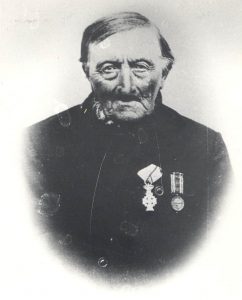
The man:
The idea:
In 1912, a Niels Sørensen from Lem obtained an account of how the invention of the spinning wheel took place (Skive Folkeblad 15.10.1912):
“Jens Væver says that for a long time he wondered whether it would not be possible, independent of land and beach, to get out on the deep waters, wherever the flounder is staying…
Jens Væver speculated and speculated, and when a sick neighbor sent him to Hjelm Mølle one day in the autumn of 1848 to consult a wise man living there, he speculated and speculated again and then found out how the wadding should be made…
When Jens Væver had finished his rope at the end of December, he wanted to try it out; but then it turned out that his anchor could not hold the boat, so when he and his partner started pulling the rope, it was the boat that was pulled to the rope instead of the other way around…
}} “Then he did a good job,” says Jens Væver, “but then he borrowed a bigger and better anchor from P. Dath in Gammelhede, and now it was the seine and the fish that had to go to the boat…”
Voddet:

The seine is set out by casting an anchor from a boat with a buoy, attaching a seine rope to the buoy, sailing the seine rope out in a straight line, casting the seine bag itself and sailing the second seine rope out at an angle of 90 degrees or more to the first. When there is no more rope on board, tie it to the boat and start dragging the rope up to the buoy. The boat is moored to the anchor and the rope is hauled in and finally the seine is recovered. You leave the anchor in place and make the next move so that you don’t overlap the area you’ve already fished. In this way, you “spin” the compass around the anchor, from which the fishing and the seine are said to take their name.
Sources:
Alan Hjorth Rasmussen; Jens Væver og det jyske ålevodfiskeri. Limfjord Museum 1991.
Skive Folkeblad.
www.skagenguide.dk/fiskeri/fangst/snurre
#Krejbjerg #fishing #inventor #invention #genius #Salling #Dannebrog Cross #lanyard