Gyro, Skive Jernstøberi og Maskinfabrik was a large iron foundry in Skive located on Østerbro. Originally founded as Skive ny Jernstøberi to separate it from Skive Jernstøberi on Frederiksgade. In 1919, the name was changed to Skive Jernstøberi og Maskinfabrik, and later became known as “GYRO” after their landmark “gyro grinder”.
The early days
Skive Jernstøberi was founded by two brothers, Anders and Jens Christian Johansen. The two brothers had originally had a wooden shoe workshop in their hometown Ytterup, just north of Roslev, where they made clogs by machine. As the brothers often had trouble finding the parts they needed for the machines, they started a small metal foundry in the town.
They soon ran out of space and bought a plot of land on Skive Holme in 1880 – a filled-in meadow area between Skive Å and Skive Railway Station, which would later become known as Østerbro. The move was initiated by timber merchant Jesper Christensen, Skive, who injected money into the company.
Relocation to Skive
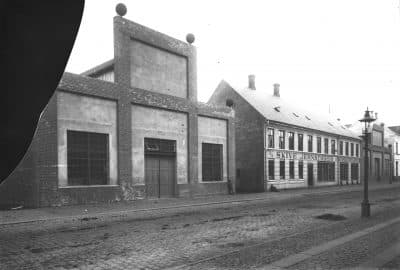
In 1882, an additional outbuilding and warehouse were built. Former miller at Skive Mølle, Christian Nielsen, invested the profits from the sale of the mill in the iron foundry and joined the daily management as business manager.
By 1890, the company employed 40 people, making it Skive’s largest industrial company. The company supplied products to agriculture and dairies, among others.
As the company grew, there was a desire for additional capital. In 1897, the company was transformed into a limited company with a share capital of DKK 100,000 – half of the share capital was provided by 10 local investors. Christian Nielsen and Jens Christian Johansen retained the other half of the share capital. Anders Johansen had died in 1891 and later in the expansion year 1897, the founder Jens Chr. Johansen stepped down from the management. The technical director was replaced by C. C. Hansen was hired as technical director and under his leadership, production expanded in versatility and scope.
After Christian Nielsen’s death in 1909, the company was sold a couple of times, in 1919 to Siliam Bjerre.
He had a great interest in electricity and expanded operations with electrical installation. This resulted, among other things, in electrical installation for the Tange plant and thereby fixed power in Skive.
The gyro grinder. Villemoes fertilizer spreader and the WYTA trailer
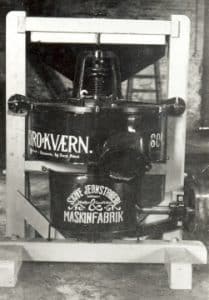
In 1924, the big change for the company was the invention and patenting of the Gyro grinder. The grinder, which had many advantages (stable setup, self-regulating grain feed and a design that limited the amount of grain that was ground into dust) ended up being what saved the company. The 1920s were otherwise characterized by a mess in the accounts and the bankruptcy of Skive Bank.
In 1927, Skive Jernstøberi won the exclusive right to produce the Villemoes fertilizer spreader, a modern fertilizer spreader that distributed fertilizer efficiently and was therefore highly sought after by farmers at home and abroad.
The company had new owners in 1929 when brothers Erling and Torben Foss took over. After many years of losses, the accounts for 1930 showed a modest profit. Sales grew steadily despite the agricultural crisis.
The Gyro grinder became so important to the iron foundry that in 1933 the entire company was named after it – A/S Gyro, Skive Jernstøberi og Maskinfabrik
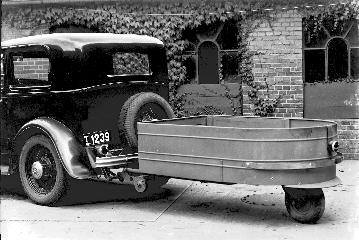
With the growth of motoring in Denmark, Gyro patented a small one-wheeled closed or open trailer for cars called the WYTA. In the days before vans were common, it was widely used by small business owners who could easily use the car for both business and private use.
The occupation
During the occupation, Gyros deliberately avoided almost all work for the German Wehrmacht and was therefore not a target for sabotage etc… The lack of raw materials was a big problem, and to avoid having to lay off employees who could be forced to work for the Germans, the company undertook completely different work, for example by buying and running a peat bog.
From expansion to closure
In the 1950s, the space at the address in Østerbro started to become very cramped and various expansions were attempted. First Viborgvej 1 (the former margarine factory / clay factory), and then the adjacent buildings on Østerbro
Production of the three successful products continued, but besides them, the only new success was the GYRO coffee grinders, which ended up in stores across the country.
In the late 60s, things started to go downhill fast for the company. Strikes, layoffs, and shift work characterized the factory. As new orders came in, it quickly became clear that the old factory in Østerbro could not accommodate them, and a new building west of the city in Lundhede was started. The old factory in Østerbro was sold to Skive Municipality.
In 1970, the company had a total of around 150 employees. Production was concentrated on fertilizer spreaders, front loaders and green harvesters.
By the end of October 1973, production was underway in the new factory at Gyrovej 1-5.
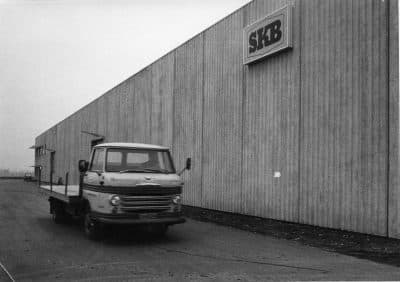
In the same year, Gyro also acquired SKB cranes located in North Zealand. Sales of cranes looked so promising that they started producing cranes in Skive and expanded with another factory hall, which was commissioned in 1975. However, things did not go well for the new combined company. Expectations in the crane market were not met and sales of agricultural machinery fell. SBK Cranes ended the financial year with a large deficit, which was covered by loans from Gyro. This left two companies in crisis.
In 1976, Gyro was taken over by Thrige-Titan. Under the common name T-T Agro Industri A/S, Thrige-Titan brought together several companies in the years 1976-81: Gyro, Veto (front loaders), Holstebro Jernstøberi, Roland (including unloaders), Lindinger (field sprayers), Nordsten (seeders).
T-T Agro Industri A/S was now the largest agricultural machinery manufacturer in Denmark with approximately 420 employees.
With the takeover of Holstebro Jernstøberi, there was no room for Skive Jernstøberi in the new company and the last casting took place at Østerbro on June 8, 1978.
In 2000, T-T Agro sold Veto to Swedish Ålö (Nordsten sold to Kongskilde) and T-T Agro ceased.
Production in Skive also ceased.
Directors
1882-1891 Anders and Jens Christian Johansen & Christian Nielsen
1891-1897 Jens Christian Johansen & Christian Nielsen
1897-1909 Christian Nielsen
1909-1910 C.C. Hansen
1910-1912 Starche and Amstrup
1912- 1919 Johannes Johansen
1919- 1932 Silliam Bjerre
1932-1946 Mads Gad
1946-1952 Torben Fos
1952-1966 Poul Møller and Einar Foss
1966-1967 Arne Kristensen
1967-1969 Kai Gørtz
1969-1976 Ulf Nielsen
Sources
- https://rethinklandbrugshistorien.dk/wiki/skive-ny-jernstoeberi-oesterbro-7-skive/
- Skivebogen 1993, p. 78-108
- Skivebogen 1994, p. 23-60
- History of Skive municipality from 1880 – 1940. Skive Museums Forlag 2002, p. 439–441
- The history of Skive municipality from 1940 – 2003. Skive Museums Forlag 2002, p. 141-148
- https://www.nimbusskive.dk/wyta/wyta.htm
- Images : Skive Byarkiv – www.arkiv.dk