West of Skive’s city center lies Toldstien. It is the last visible remnants of the customs border that surrounded Skive Købstad until 1852.
Consumption tax
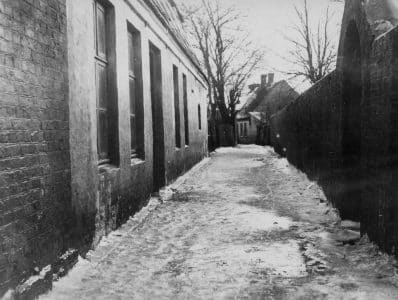
Skive’s status as a market town meant that the farmers in the Skive area were obliged to trade their goods at the market square in Skive. In 1671 and 1700, customs duties were introduced on goods brought into the market town. This meant that all traders had to pay a so-called consumption tax when they passed one of the three barriers into the city. Finally, in 1707, a solid wooden fence was erected around the town, and outside the fence a path was gradually trodden by customs officers who kept an eye out for smuggling of goods over the fence. The path was later named Toldsten and is partially preserved today. Since 2019, it has been marked with counterfeit coins in the pavement.
Customs officers and posekiggers
The customs service was headed by a customs officer, and under him there were a number of sub-officers, who were also called posekiggere. One of the reasons for this was that they kept an eye out at the barriers to see if travelers had clean flour in their bags or hidden contraband in the flour bags. However, some succeeded in smuggling goods in, according to a story from 1820, when a farmer smuggled a pig disguised as a priest past the customs officers.
The plank fence and the customs border disappeared in 1852, when a consequence of the Constitution of 1849 was that the market towns’ trade monopoly disappeared.
Sources
- Mortensen, Svend: “Om toldere og syndere i det gamle Skive”, Skiveegnens Jul 1991, page 5-11.
- The customs path on the web