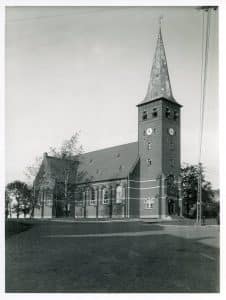
Skive Church is commonly known as the Red Church and is one of Skive City’s two side churches.
The city grows out of Vor Frue Kirke
In the late 1800s, Skive experienced a significant increase in population. The city grew from around 1,000 inhabitants in 1840 to 6,000 inhabitants in 1900. This created a need for a larger church in the city. The original plan was to demolish the old medieval church, Vor Frue Kirke (the white church), and build a new church on the site, but unusual frescoes on the vaults of Vor Frue Kirke changed the plans and the medieval church was allowed to stay.
Skive Church instead took its place next to Vor Frue Kirke. Skive Church was built between 1895-98 and the construction was made possible by a grant of DKK 100,000 from pharmacist G. Norgaard and his wife, which corresponded to 2/3 of the construction cost.
The location of the church is partly because the architect, H. J. Holm, wanted to tie the church and the city together and therefore placed the 37 meter high church tower so that it could be seen through the streets almost all the way from Østertorv. The church’s south-north orientation is due to a wish from Skive City Council to make room for a horse market west of the church building, where there is currently (2025) a parking lot.
The architecture of the church
The church is built in a historicist style with many details from the Renaissance. It is built in red brick cross-bracing on a granite plinth, decorated with chalk stone bands and masonry patterns around the doors and windows, varying from window to window. The windows themselves have a slender profile. The brick pilasters are finished with “monks and nuns”. The copper-plated roofs show how details can have both practical and aesthetic significance. Above the tower is a gold-plated wind vane.
The story of the brave carpenter
There is a story that during the construction of Skive Church there was a particularly brave journeyman carpenter named Morten Christensen who chose to stand on his head on top of the spire while it was still under construction. There was no photographer present on the day, but a Skive photographer later made a manipulation where you can see what it looked like when Morten Christensen stood upside down on the spire.

Sources
Eskildsen, Jens and Mortensen, Niels (1998). 43 exciting buildings in Skive Bykerne. Skive Museums Forlag.