The initiative to establish a city history archive came from the Historical Society of Skive and the surrounding area in the late 1950s. In several municipalities across the country, local archives were being set up, often in collaboration with libraries. In Skive, the municipal library at Posthustorvet / Vestergade 1 offered to house the archive in a similar way, financed from the library’s budget.
1. byApril 1966, everything was in place, and Skive City History Archive became an independent department of Skive Municipal Library for the next 18 years. The statutes for Skive Byhistoriske Arkiv had 6 points, a work program of 22 points and instructions for the daily manager were drawn up. The purpose clause was: to increase interest in the history of the city and the region.
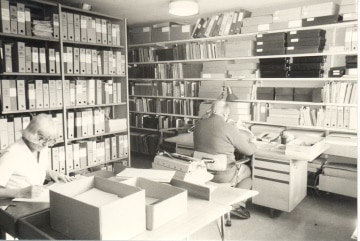
town history archive, in Vestergade 1 ca. 1980
Collection work was started immediately by contacting the public. In addition, the transfer of approx. 500 numbers of records of a local historical nature from the museum’s archive was initiated. There were 100 minutes, 80 class photos and other archival material from the school archives and another major transfer when Skive Naverlaug had to vacate its premises. The first major private archive was donated by pastry chef Miss A. Michelsen, and during the first few years, many more were added.
The Historical Society’s secretary, teacher Svend Mortensen, became the first archive manager. He was head of archives for 23 years, until he turned 70.
For many years, annual reports for the Skive City History Archive were printed in the Historical Society’s yearbooks, and there was also great interest from Skive Folkeblad with many mentions. It appears that a great deal of collecting work was done from the start. All types of records relating to people from the city and the surrounding area were collected, such as personal papers, documents and evidence, etc. Another group of records came from associations and companies, such as minutes, statutes, accounts and the like. A lot of work was also done to collect photos and films from the area, and already in the early years of the archive, efforts were made to record interviews e.g. about the occupation years, for example.
9 years at Østerbro 9 A
The library began to run out of space, so in September 1984 the archive moved to Østerbro 9 A 1st floor. At the same time, the archive was transferred from Skive Municipal Library to be a department of Skive Museum.
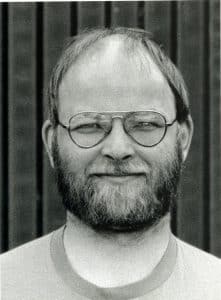
In 1989, historian Niels Mortensen(son of the archive’s first director) took over as city archivist. Niels Mortensen had many busy years as head of the archive, with a lot of communication work in writing, film screenings, lectures and city walks. There was great interest in local history in the area, and all outreach activities were very well attended. This resulted in many returns, which put so much pressure on storage facilities that the archive had to refrain from advertising the receipt of records.
The premises in Østerbro were not optimal. Access conditions were not good. There was not enough space for both staff and records, despite the fact that there was storage in the city, including at the seminary. In 1991, the municipality sold the building in Østerbro, and the archive signed a lease with the new owners, but it was clear that better conditions had to be found for the archive.
25 years in Asylgade
In the fall of 1993, an agreement was reached to provide storage in the library’s basement under the old Kvickly building in Asylgade. The archive itself moved to premises in Asylgade and here the work of collection and dissemination could continue. Many city walks with different themes and writings about the city’s personalities and businesses were issued from Skive City History Archive in those years.
Around 2015-2016, the archive is increasingly referred to as Skive Byarkiv rather than the original somewhat longer name “Skive Byhistoriske Arkiv”.
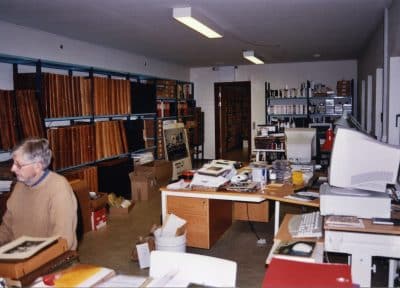
Office and warehouse on Asylgade
A transition on Havnevej
In 2018, an overall solution was found for the museum problem. Rønbjerg Old School was to house the museum’s administration and archives with refrigerated facilities for color slides, negatives, films and audiotapes. The dilapidated museum building on Havnevej was expanded and refurbished. In March 2018, the archive moved from Asylgade to premises at Skive Museum on Havnevej, namely the first floor above the lecture hall, and in 2019 the archives were finally moved to the newly built 5000 m2 high storage facility in Rønbjerg.
In 2019, Niels Mortensen retired and historian Kristian Buhl Thomsen became the new city archivist.
City archive at Gl. Skivehus
In the fall of 2022, the archive moved to Gammel Skivehus on Søndre Boulevard 1A, Skive’s oldest non-denominational building. The municipality had acquired the building a few years earlier, and after the renovation, there were opportunities for the city archive to be housed there. The premises at Gammel Skivehus house a reading room and book collection as well as workrooms for the city archivist, a couple of archive assistants and the archive’s 10-12 volunteer employees. The volunteers work with collecting, registering, preserving and making local historical sources available, including scanning photos, digitizing films and audiotapes on the website Arkiv.dk. Walks on selected themes are organized and a large number of employees and volunteers put a lot of work into producing articles for SkiveWiki. In connection with the city anniversary, the city archivist is behind the publication of volume 4 of Skive’s Municipal History, which will cover the period from 1970 to the present.
Skive’s oldest secular building
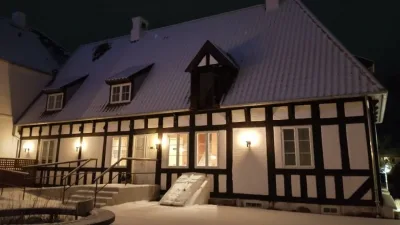
Gammel Skivehus had undergone extensive restoration with respect for the building’s history. The basement under the house dates from the late 15th century, while the timber-framed house itself dates from 1719. It was at Gammel Skivehus that the royal lords lived from the 1300s to the 1600s. Back then, Gammel Skivehus was a much larger building complex than today. The sheriff administered the royal estate and was responsible for collecting taxes. This made him the king’s highest official in the Skive region. Gammel Skivehus later passed into private ownership as a manor house and later from 1928 as part of the hotel complex next door.
Organization
Skive City Archives is part of Museum Sallings Arkivteam, which in addition to the City Archives consists of the local archives for Fur, Sundsøre, Sallingsund and Spøttrup. The City Archive is a member of the Association of Local Archives.
Municipal archives
Since 2007, the City Archives has had the status of a section 7 municipal archive. The archive stores municipal paper documents that are subject to preservation according to the Archives Act. These are mainly from the period 1868-2006.
The municipal records come from Skive Municipality, Sallingsund, Spøttrup and Sundsøre Municipalities as well as from the former Skive Købstad and the area’s former parish municipalities. When the municipalities were merged in 2007, the archives of the 4 old municipalities were gathered in the old utility building in Jebjerg, which the municipality had rented. The archives took up 1.2 km of shelf space. It was cheaper to do the storage themselves than to pay – at the time, the National Archives in Viborg charged DKK 1600 per meter of shelf space.
In 2019, the municipal archive was also moved from Jebjerg to Rønbjerg, where it is still housed. Skive Municipality’s digital archive files are archived at the National Archives.