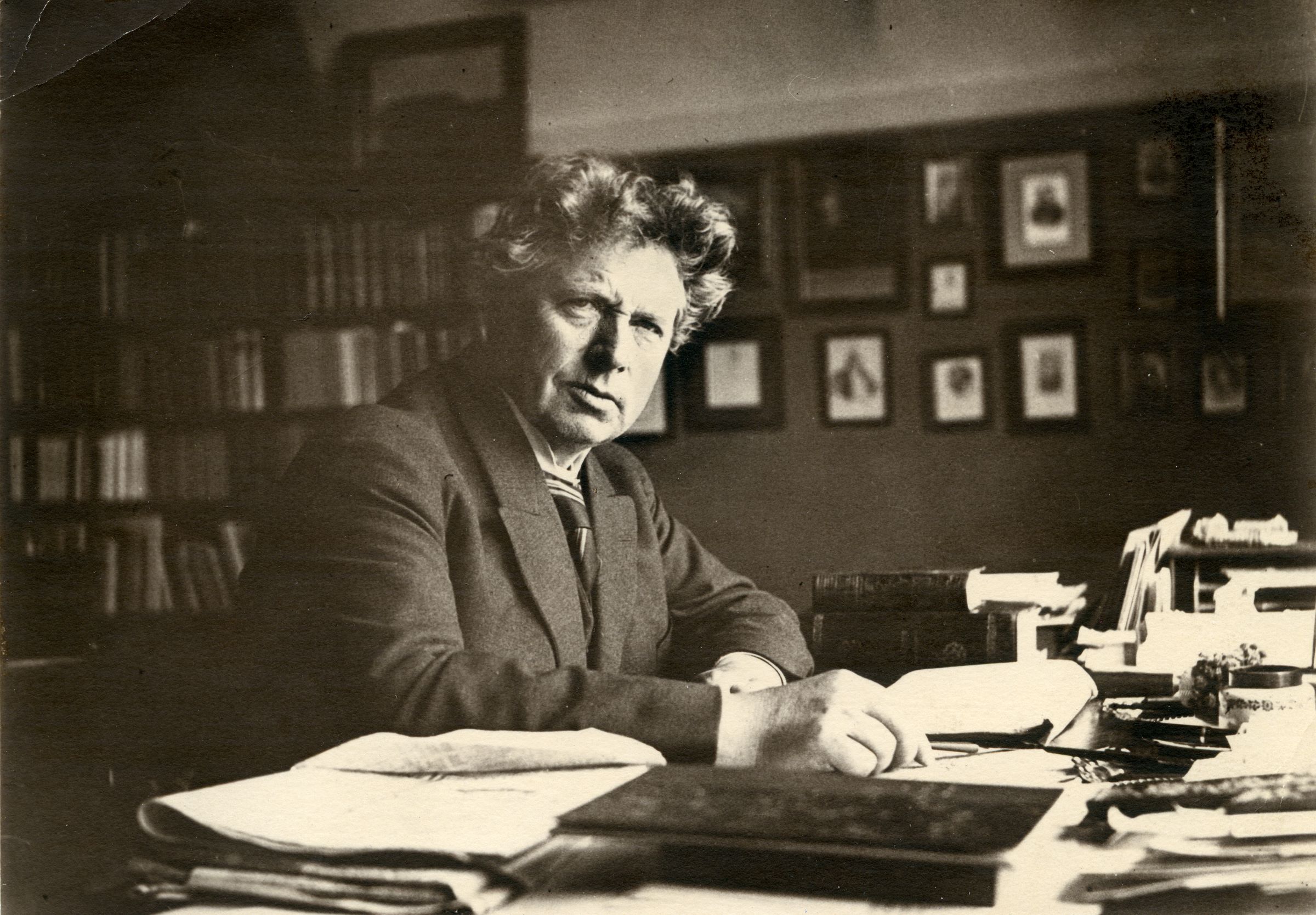
The poet Jeppe Aakjær ‘s home in Jenle has become a museum of Nanna and Jeppe Aakjær’s life and artistic legacy.
A young man from Fly
Jeppe Aakjær was born on September 10, 1866, the second oldest son of farmer Jens Peder Jensen (1835-1901) and Catrine Marie (Margrethe) Jeppesen (1839-1890). He was baptized Jeppe Jensen, but later took the name Aakjær after the area in Fly where the family came from. Jeppe Aakjær grew up in a family of 8 siblings. He had 3 sisters and 4 brothers, of which the eldest sister, Margrethe, inherited the family farm in Fly.
Aakjær started school in Fly, where, after a few years of schooling, he got the newly qualified teacher – Niels Jakobsen – who did not believe in memorization, but instead focused on stories. Aakjær found great joy in this form of teaching and Jeppe Aakjær continued to visit Jakobsen’s home after he had been confirmed. Here he read in Højskolebladet that the folklore collector Evald Tang Kristensen was looking for songs, myths and songs of skillings for publication in several books. Aakjær then traveled around Salling and collected several hundred legends, myths, folk songs, old rhymes, etc. Evald Tang Kristensen credited Jeppe Aakjær with the text: “Submitted by bachelor Jeppe Jensen from Fly”.
After serving for a period of time, Jeppe Aakjær came to Staby Højskole with the help of teacher Jakobsens. Here he could satisfy his desire to read and acquire academic knowledge. After his stay at the folk high school, he got his blood pumping, which led to him being allowed to take the preliminary exam from Blågård Seminarium in Copenhagen in 1886.
Marriage to Marie Bregendal
After graduating, Jeppe Aakjær returned home to Fly, where he eagerly engaged in political life and shared the ideas and thoughts he had brought with him from Copenhagen. One evening in 1887, he gave a lecture on the French Revolution, which caught the attention of the local priest. The priest reported Jeppe Aakjær to the judge in Viborg, as he believed that Aakjær had encouraged revolution. Jeppe Aakjær was subsequently remanded in custody for 17 days. After he was released, the case was dropped.
It was during these years and during these political meetings that Jeppe Aakjær met Marie Bregendahl. Bregendahl was the daughter of a landlord from the Bregendahl estate in Fly parish. Jeppe Aakjær and Marie Bregendahl fell in love and moved to Copenhagen together. She had an inheritance from her late mother, which they used to buy an apartment and start a boarding house “Det jyske Pensionat”. After which they moved in together, despite not being married.
In Copenhagen, Jeppe Aakjær would graduate from high school and study History at the University of Copenhagen. Marie Bregendal was to support the couple with income from the boarding house. A year later, Marie became pregnant, the couple married and their son Svend Aakjær (1894-1963) was born six months later.
The couple’s marriage went rapidly downhill after Svend’s birth. Bregendahl struggled to make ends meet and wanted Aakjær to take a job to help support the family, which led to a rift between the couple. In 1898, Aakjær had to give up his studies and took a job as a proofreader at the newspaper Politiken. Jeppe Aakjær left Marie Bregendahl and her son in 1900, but the couple separated in 1902 and finally divorced in 1907.
Marriage with Nanna Krogh
Jeppe Aakjær met Nanna Krogh from Måbjerg near Holstebro in 1902. She was a woodwork teacher at the Richardt Sløjdinstitut in Copenhagen from 1900-1905 and then worked at the Royal Danish Porcelain Factory. Porcelain Factory until 1907, when she married Jeppe Aakjær.
Upon meeting Nanna Krogh, Jeppe Aakjær began the 5-year separation process so that he could divorce Marie Bregendahl. At the same time, he began to explore the possibilities of returning home to Skiveegnen. With the help of friends and acquaintances, he buys a piece of land near Grønning, where he and Nanna build the farm Jenle. Aakjær moves in in March 1907 and Nanna Krogh moves with him after their wedding in April the same year.
Nanna and Jeppe Aakjær have a daughter Solvejg Aakjær (1908-2001, née Bjerre) and a son Esben Aakjær (1911-1958).
Lecturer and author
In 1904, the novel Vredens Børn (Children of Wrath) was published, the book caused a stir and created a bad atmosphere among the Aakjær farmers, as the book contained detailed descriptions of how servants in the countryside were treated and lived in squalid chambers. After the many reports about the book’s content, the Danish parliament took up the matter and set up a servants’ commission, which resulted in the Servants’ Act of 1854 being repealed.
After this, Jeppe Aakjær’s writing career took off and he published the historical novel Jens Langkniv in 1915, later filmed in 1940, and Livet paa Hegnsgaard in 1907, Naar Bønder elsker in 1911 (filmed in 1942) and his collected works in 1918-1919.
Jeppe Aakjær was also a frequent lecturer. He often traveled around the country to share his views on farmers and workers.
Illness and death
Jeppe Aakjær was affected by illness for much of his life. He suffered greatly from diabetes and was hospitalized at Skodsborg Sanatorium from March 1927 to May 1928 with diabetes and subsequent gangrene in one foot. It was during this period of hospitalization and illness that he began writing his memoirs, of which he only managed to write three volumes before his death on April 22, 1930.
Before his death, Jeppe Aakjær had decided that he would be cremated at Bispebjerg Crematorium in Copenhagen. Therefore, Jeppe Aakjær’s coffin was transported from Jenle to Skive, Thorning and Aarhus, from where he was transported by ship to Copenhagen. In each city, thousands of people turned out to honor and remember the beloved poet. In Copenhagen, a memorial ceremony was held in Idrættens hus, which was also broadcast live on the radio.
Aakjær’s urn is placed in the heather hills south of Jenle with a view of the farmhouse.
Sources:
- Aakjærselskabet. Jeppe’s life and authorship. Jeppe’s life and authorship – Aakjærselskabet (21.5.2025)
- Denmark’s national encyclopedia. Claus Bech (2023). Jeppe Aakjær. Jeppe Aakjær – Dansk Biografisk Leksikon | Lex (21.5.2025)