Anders Peter Pedersen grew up in modest circumstances in Brårup. In 1898 he founded Skive Børstefabrik – later Vikan, which he and his sons grew into a large company. More than 125 years after its founding, Vikan is still a large, international Skive-based company.
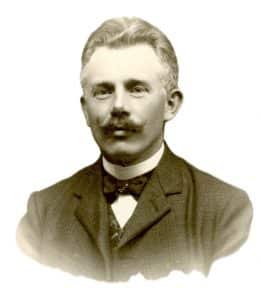
The background
A P Pedersen begins his memoirs by writing :
“I grew up in a time when people made little demand for leisure and pocket money, but great demands on the individual’s working hours and work performance, in a time when thrift was a matter of course, godliness a rule and work a blessing.”
A P Pedersen’s mother – Ane Jensen – came from a farm in Sdr. Lem and his father – bricklayer Jens Pedersen – was from Vadum. After the wedding, they bought a small farm in Iglsø in Fly Parish, Fjends Herred. To get closer to his father’s bricklaying work, they moved to a property with 2 apartments in Brårup – Bråruphus – where there was enough land to keep a cow. As a bricklayer, Jens Pedersen helped to build the west wing of the hospital and later worked on the brush factory’s house in Thinggade.
The family’s six children grew up in one of the two-room apartments in Bråruphus – five sons and one daughter. AP Pedersen was the oldest, born on July 2, 1869. In the other apartment lived 2 families. The children were trained to help out, e.g. AP had to card wool and stuff the children’s stockings. carding wool and darning the children’s socks.
The 2 brothers Carl and Vilhelm died of “gastric fever” (typhus) as children. 1 brother – Anton Pedersen – became a master painter in Christiansgade in Skive and 1 brother – Jens Chr. Pedersen – became a gardener in Brårup. His sister married teacher Kristian Jensen Møller from Rødding, who became a radical member of parliament in Lejrekredsen.
Their childhood home was religiously influenced by the Grundtvig movement. The priests in Skive were not exactly what the parents wanted, so they often walked to Lem. AP Pedersen’s father was a member of the first elected parish council from 1905 – 1909.
Schooling
AP Pedersen started school at the age of 6 in a small private school in Søndergade, after a year he switched to the municipal school in Østergade. At the age of 11, he went to work for elderly relatives in Sdr. Lem, his schooling continued at Opperby school. He stayed in Sdr. Lem until his confirmation. In addition to board, lodging and clogs, his wages for the three years were a hymn book.
AP Pedersen became a priest in Sdr. Lem with the Grundtvigian J. H. Monrad and when he left, AP Pedersen was confirmed in Håsum with the Grundtvigian August Ludvig Schrøder.
After confirmation, he served in a Grundtvigian home in Rødding Grundvad with the progressive but very demanding Søren Møller. AP was small in stature and didn’t have much strength, but he made every effort to keep up and tried to complete the hard work despite a bulging finger. However, it was insurmountable for him, and eventually he ran away from the site to his parents’ home. At home, there was no forgiveness. As soon as the finger was better, his father accompanied him back to Søren Møller and he had to stay until the November changeover day. After 1 year in Grundvad, AP Pedersen got a job at the vicarage in Lem.
Start at the brush bindery
AP Pedersen could not imagine that he could physically stay with his small business.
At the time, handicrafts were strongly encouraged and while he was at the vicarage in Lem, he came up with the idea of tying brushes. He bought brushwood in Skive, the bristles he could get in the countryside, and then he started making brushes that he sold to neighbors and others.
His parents couldn’t support him financially, but his father helped him get an apprenticeship with Søren Christensen in Bomhuset on Østertorv, and his mother helped him during the apprenticeship with clothes and laundry. The apprenticeship was for 4 years, and initially the salary was just room and board. It was a bit of a struggle to find space for accommodation, but it got better after moving to the boathouse in Vestergade.
AP spent his apprenticeship improving his skills, even though his master would not give him up to go to technical school. He was also diligent in earning money in all sorts of ways and he had a small savings when he became a journeyman.
Apprentice brush maker
AP Pedersen used the 16 months he spent as a soldier at Wildersgade Barracks in Copenhagen to broaden his horizons in many ways, including museum visits. He also sought out brush makers and wholesalers and made good contacts. When he returned home to Skive, he wanted to expand his knowledge of wood qualities and got a job with sawmill owner Christensen, who had a sawmill where Andelsslagteriet later came to be located.
After 3 years at the sawmill, AP Pedersen was offered the position of foreman, but he wanted to return to the brushwood bindery. His old master offered him a share of the business and he accepted, even though he had his doubts about whether they could get along. It turned out that the doubts were justified. AP Pedersen wanted to base the prices of the brushes on calculations, which the old master did not agree with. AP Pedersen therefore took the idea of becoming self-employed seriously.
Own business
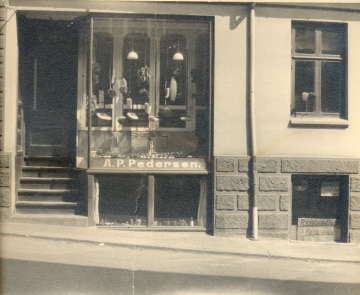
AP Pedersen found premises at the top of Thinggade, where Skive Avis had previously had a print shop. AP got the printing house for a shop and workshop and a room upstairs for an annual rent of DKK 150, and on May 1, 1898, he could start.
The premises were located in the courtyard and AP Pedersen was worried about whether there would be enough customers, but soon the small shop was crowded. AP had the principle of making good goods and providing customers with good service, which he realized early on was the right business ethic.
Soon, expansions were lining up. In 1900, AP bought the property at Thinggade 5 with loans from family and acquaintances as well as a bank.
The family
In 1897, AP Pedersen became engaged to Marie Hansen, daughter of hawker and later sickness fund chairman P. C. Hansen, Østergade. She was of the same nature as AP – industrious and thrifty. They married on November 29, 1899. When the property in Thinggade was acquired, the couple moved into the ground floor apartment there.
Eldest son Carl Vilhelm was born on May 25, 1901, then Ella on December 27, 1904, Gunnar on January 3, 1909 and finally Gerda on June 17, 1913, all the children were born in Thinggade and baptized in Skive Church.
The 2 sons were both apprenticed in the brush bindery in Thinggade on equal terms with the other apprentices. Carl Vilhelm attended business school in Aarhus and then traveled to Germany to study machines for use in the brush industry. He joined the company at home and later made several machine purchases in Germany. Gunnar joined the wood products department of the company, and after finishing business school in Aarhus, he received further training in England with partners to get ready to join the company.
The growth of the business
AP wanted to grow the business. He made quality products to compete with other manufacturers. He visited local merchants and cooperatives, who soon became his good customers, and then moved on to neighboring towns and their hinterlands.
With the great development in the dairy industry, AP realized that there could be a market there and he visited the dairies to see what needs they had for good and practical brushes. Once he had come up with a brush type, he sent them for testing to the dairies, who liked them and became good customers. When the dairies later joined forces in “Mejeriernes Fællesindkøb”, AP Pedersen became their supplier. The idea of also becoming a supplier to the “Fællesforeningen for Danmarks Brugsforeninger” was a natural fit and AP negotiated an agreement.
The company was hit hard by fire in 1918, and was underinsured, but through hard work they managed to get back on their feet.
In the twenties, there was a need to expand and it was fortunate that the neighboring property no. 3 was for sale. It was a rather old property like Thinggade 5, so AP Pedersen and his sons agreed that both houses should be demolished. In 1929-30, a large modern business was built, designed by architect Toft-Hansen, who with the construction of Topps konditori on the corner of Torvegade and Østergade had shown that he could handle larger projects. He was somewhat related to the Pedersens, had been AP’s first city boy and had contributed significantly to the construction of Solskrænten. AP Pedersen expressed in his memoirs: “it was a special pleasure that my boy had driven it so far.”
Solskrænten – Holstebrovej 23:
AP Pedersen and his wife had fallen for the view down over the river valley from the elevated Holstebrovej and had bought a strip of land where they grew potatoes and planted 100 fruit trees. AP Pedersen had an eye for a beautiful garden. He placed stones where it looked natural, and flowers and plants were brought out in individual places where they matched in shape and color.
Around 1915, the business expanded so much in Thinggade that the space for the family became cramped. They contacted architect E.V. Lind and asked him to help them with a house, but at the same time they asked that the work be left as much as possible to architect Toft Hansen, who was an assistant to Lind at the time. Toft Hansen had a special relationship with the family. In August 1916, the family moved into their new home on Solskrænten.
Even before the house was built at Holstebrovej 23, the garden was known as an attraction and a popular destination. Many associations visited the garden, and this continued throughout the time AP Pedersen was in charge of its care.
Political stance
AP Pedersen supported his youth friend Carl Hansen’s idea that “Skive Folkeblad”, then owned by Marius Jensen, should be acquired by the city’s and the region’s leftists, so they could decide for themselves who should write in the magazine and what should be written in it.
The idea was realized on July 1, 1906, when the magazine started under the new form of government. The ownership was structured in such a way that no private individual could profit from the venture. It therefore became a self-governing institution. Behind it, there was a group of guarantors who would provide subsidies if there was a deficit. It was not intended to be a business that would generate large surpluses, but the magazine was to be
but the magazine was to be delivered at the lowest possible price, and the printed matter supplied by the magazine’s printer was also to be delivered at the lowest possible price. The magazine was founded on an entirely idealistic basis.
AP Pedersen was also involved when a left-wing association was founded in Skive. He joined the board and got to know editor Nerup. He was a man who fought for the ideas of the left, and when others wanted to blow off steam, he was there immediately. “It’s about gaining influence in the city, getting leftists into the city council, in short, showing the flag everywhere,” he said.
If there was an election, the board had to keep abreast of who voted during the day, and at the end of the day, messages had to be sent to those who were thought to be fellow citizens and who had not voted to come and do their civic duty. The sick and elderly had to be taken to the polling station. They also managed to put left-wingers on the city council.
AP Pedersen supported Carl Hansen’s project to start a temperance hotel and a property was also bought in Torvegade, where something was run as a temperance hotel, but it was not a success.
Otium
In 1933, when AP turned 64, he let his sons Carl Vilhelm and Gunnar take over the factory, and they ran it as a partnership, but from New Year 1949 as a limited company. The factory was run along the same lines with the two sons as managers. AP Pedersen continued to follow the work at the factory.
Marie Hansen died in 1937, after which AP Pedersen moved to Feldinghus on Resenvej 49. He died on November 29, 1954 – 85 years old.
Source:
- Skivebogen 1949 A P Pedersen Liv og Virke v. Niels P. Bjerregaard https://slaegtsbibliotek.dk/928050.pdf